Posts

Showing posts with the label Polymer Chemistry

Kinetics of Cationic Polymerization

Image
" Ionic polymerization is defined as a type of addition polymerization in which the active centres (or intermediates) are ions or ion pairs ". It can be considered as an alternative to free radical polymerization. Cationic polymerization reaction is one of two processes of Ionic polymerization to convert a monomer molecule into a polymer.  " Cationic polymerization is defined as a type of addition ionic polymerization in which the active centres are cations (or positive ions) ".  In this, the cationic initiator is used to transfer the positive charge onto the monomer molecule so that it becomes reactive. This reactive monomer reacts with other monomer molecules to form a polymer in the same way that a free radical does.  Examples of polymers formed by Cationic polymerization are Poly-isobutylene (PIB), Poly-butene and Butyl rubber, etc. The types of monomers required for cationic polymerization are limited to " alkanes " with " electron donating subst...
Kinetics of Free Radical Polymerization

Image
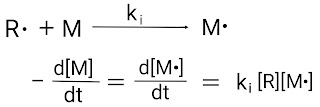
" Chain-growth polymerization or addition polymerization reaction is a polymerization technique where unsaturated monomer (means containing double and triple bonds in their molecular formula) molecules add onto the active site on a growing polymer chain one at a time ".  Since, we know that  d epending on this active site present on the growing polymer chain, there are three types of addition polymerization:  free radical polymerization, ionic polymerization, and coordination polymerization.  Free radical polymerization is one of those types of additional polymerization in which the active site is free radical. In this, initiators are used to generate free radicals. Free radical is denoted as "M•".  ➛ Initiator molecules are of the following types; (a) Thermal initiators (such as peroxides, azo-compounds) (b) Photochemical initiators (such as Disulfides, ketones, Azo, Peroxides,etc.) (c) Redox initiators (such as Fenton reagent) (d) Ionising initiators ( su...

Kinetics of Addition Polymerization

Image
" Polymerization technique is defined as the fundamental process by which low molecular weight compounds are converted into high molecular weight compounds (means, polymers) ".             " Chain-growth polymerization reaction " also known as " Addition polymerization reaction ". In this polymerization reactions, monomer molecules bond to each other to form a larger molecule called a polymer, without removing any of the smaller molecules as a byproduct. An addition polymer is a very long organic molecule formed as a result of an addition reaction between monomers with unsaturated carbon-carbon bonds.  ☛ The kinetics of addition polymerization proceeds according to the chain polymerization mechanism that occurs in three basic steps; 1) Chain initiation 2) Chain propagation 3) Chain termination Since, addition polymerization occurs in four ways (free radical/cationic/anionic/co-ordination Polymerization) therefore all its types follow the same kine...

Chain Polymerization Mechanism

Image
First of all, we learn about the basis of Polymerization techniques; " Polymerization technique is defined as the fundamental process by which low molecular weight compounds (Monomers) are converted into high molecular weight compounds (means, polymers) ". There are several polymerisation techniques are available but most of the polymerization techniques fall under two categories:   Addition polymerization and Condensation polymerization The mechanism of chain polymerization reaction or the chemical reaction (or other process) is the reaction in which the products themselves promote or spread the reaction. In this, reactive product or by-product causes additional reactions to take place.  (A series of events so related to each other that each one initiates the next)  This chain polymerization mechanism occurs in three basic steps; 1)  Chain Initiation 2) Chain Propagation 3) Chain Termination 1) Chain initiation  – It is the first step in the chain-growth polyme...

Types Of Addition Polymerization

Image
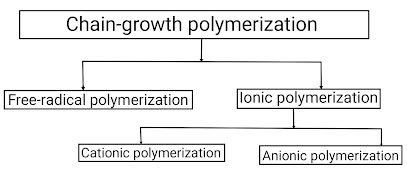
Chain-growth polymerization reaction is one of two processes to convert a monomer molecule into a polymer. Chain-growth polymerization reaction is a polymerization technique where unsaturated monomer (means containing double and triple bonds in their structural formula) molecules add onto the active site on a growing polymer chain one at a time.           Depending on this active site present on the growing polymer chain, there are three types of addition polymerization: free radical polymerization , ionic polymerization , and coordination polymerization . Out of which, coordination polymerization is rarely observed, so we will not study about it. Thus, Let us study briefly about all these types of addition polymerization reactions; (A) Free radical polymerization – Free radical polymerization is defined as a type of addition polymerization in which the active centres are free radical. It is denoted as "M•". Since free radical polymerization is a type of ad...

Poly-Dispersity Index Of Polymers

Image
First of all we should know what are polymers and how they are defined???? " A polymers is defined as a large molecule (or macromolecule), formed by joining together thousands of smaller molecule units by chemical bonds (or covalent bonds) ".  These smaller molecules that interact with each other to form a larger molecule are called " Monomers ".   To understand how the molecular weight is distributed within polymers, we study about the poly-dispersity index. " The polydispersity index measures the distribution of molecular mass in a given polymer sample ". The molecular weight of a polymer is defined as the sum of the atomic weights of each atom in the molecules, which is present in the polymer. Due to the different chain lengths of polymers, we cannot directly measure the molecular weight of the polymer. So we calculate the average molecular weight of the polymer on two basis- " Number average molecular weight "  and "Mass average molecul...

Addition Vs Condensation Polymerization

In polymer chemistry, a reaction by which smaller molecules (called monomers) react with each other to form a larger molecule (called polymers), is called " Polymerization ". There are two types of Polymerization processes in polymer chemistry and these are- (1) Addition Polymer (2) Condensation Polymer Let's compare them one by one based on their formation, molecular weight, functionality, no. of monomer used, etc. Comparation between Addition and Condensation polymerization (1) Addition polymerization is the process of adding unsaturated monomers to form an addition polymer. While Condensation polymerization is the process of combining monofunctional, bifunctional and trifunctional monomers to form a condensate polymer. (2) No formation of by-products in addition polymer whereas by-products are formed in condensation polymerization. (3) In addition polymerization, molecular weight of a resultant polymer is a multiple of monomer's molecular weight whereas in condensa...

Polymer Techniques/ Polymerization Process

Image
The word polymer is a combination of two Greek words-                Poly means 'many'             Or Mers means 'parts of unit     ☆ Poly + Mers ➝ many parts of unit In polymer chemistry;  Polymerization is a process in which thousands of smaller molecules called " monomers " join together to form larger molecules called " macromolecules/polymers ". They have high molecular weight. Or " It can also be defined as the fundamental process by which low molecular weight compounds are converted into high molecular weight compounds ".        Polymerization Processes Several different categories of polymerization reactions exist, but the most notable of which are: step-growth polymerization and chain growth polymerization.  (a)  Chain growth polymerization / Addition polymerization " Chain-growth polymerization reaction " also known as " Addition polymerization reaction ". I...

What do you understand by Polymer?

Image
Polymers forms a very important class of materials without which life seems very difficult. They are all around us in everyday use. Polymers are very large molecules which are very essential for our existence. It is a main component of our food (starch, protein, etc.), our clothes (polyester, nylon, etc.), our home (wood cellulose, alkyd paint, etc.), and our body (nucleic acid, protein, etc.) Polymers   The word polymer is a combination of two Greek words- " Poly+Mers "  Poly means 'many' Or Mers means 'parts of unit'          Poly + Mers ➝ many parts of unit Thus, " A polymers is defined as a large molecule (or macromolecule), formed by joining together thousands of smaller molecule units by chemical bonds (or covalent bonds) ".               These smaller molecules that interact with each other to form a larger molecule are called " Monomers ". In polymer chemistry, a reaction by which smaller molecules (called...

Introduction To Polymer

Image
Polymers forms a very important class of materials without which life seems very difficult. They are all around us in everyday use.  Polymers are very large molecules which are very essential for our existence. It is a main component of our food (starch, protein, etc.), our clothes (polyester, nylon, etc.), our home (wood cellulose, alkyd paint, etc.), and our body (poly (nucleic acid), protein, etc.).                     Polymers are found in abundance on the Earth's surface; either in nature or artificially prepared.  For example; We use plastic bags, cards, paper, wood, clothing, paint and endless items that contain the basic chemical composition of polymers.  Human and animal bodies are mainly made up of proteins and these proteins are the building blocks of life. They are also polymers.  Definition The word polymer is a combination of two Greek words- "Poly+Mers"           ...