Posts

Showing posts with the label Chain initiation

Kinetics of Free Radical Polymerization
Image
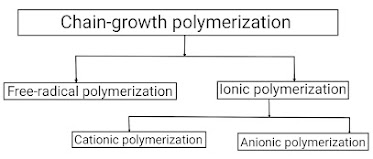
" Chain-growth polymerization or addition polymerization reaction is a polymerization technique where unsaturated monomer (means containing double and triple bonds in their molecular formula) molecules add onto the active site on a growing polymer chain one at a time ".  Since, we know that  d epending on this active site present on the growing polymer chain, there are three types of addition polymerization:  free radical polymerization, ionic polymerization, and coordination polymerization.  Free radical polymerization is one of those types of additional polymerization in which the active site is free radical. In this, initiators are used to generate free radicals. Free radical is denoted as "M•".  ➛ Initiator molecules are of the following types; (a) Thermal initiators (such as peroxides, azo-compounds) (b) Photochemical initiators (such as Disulfides, ketones, Azo, Peroxides,etc.) (c) Redox initiators (such as Fenton reagent) (d) Ionising initiators ( su...

Kinetics of Addition Polymerization

Image
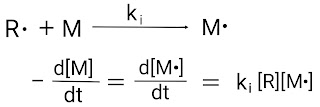
" Polymerization technique is defined as the fundamental process by which low molecular weight compounds are converted into high molecular weight compounds (means, polymers) ".             " Chain-growth polymerization reaction " also known as " Addition polymerization reaction ". In this polymerization reactions, monomer molecules bond to each other to form a larger molecule called a polymer, without removing any of the smaller molecules as a byproduct. An addition polymer is a very long organic molecule formed as a result of an addition reaction between monomers with unsaturated carbon-carbon bonds.  ☛ The kinetics of addition polymerization proceeds according to the chain polymerization mechanism that occurs in three basic steps; 1) Chain initiation 2) Chain propagation 3) Chain termination Since, addition polymerization occurs in four ways (free radical/cationic/anionic/co-ordination Polymerization) therefore all its types follow the same kine...

Types Of Addition Polymerization

Image
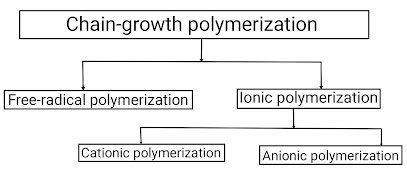
Chain-growth polymerization reaction is one of two processes to convert a monomer molecule into a polymer. Chain-growth polymerization reaction is a polymerization technique where unsaturated monomer (means containing double and triple bonds in their structural formula) molecules add onto the active site on a growing polymer chain one at a time.           Depending on this active site present on the growing polymer chain, there are three types of addition polymerization: free radical polymerization , ionic polymerization , and coordination polymerization . Out of which, coordination polymerization is rarely observed, so we will not study about it. Thus, Let us study briefly about all these types of addition polymerization reactions; (A) Free radical polymerization – Free radical polymerization is defined as a type of addition polymerization in which the active centres are free radical. It is denoted as "M•". Since free radical polymerization is a type of ad...

Chain Growth Polymerization Or Addition Polymerization

Image
Polymerization is a process in which thousands of smaller molecules called "monomers" join together to form larger molecules called "macromolecules/polymers". They have high molecular weight. Several different categories of polymerization reactions exist, but the most notable of which are: step-growth polymerization and chain growth polymerization.  Chain-growth Polymerization   Chain-growth polymerization reaction is one of two processes to convert a monomer into a polymer.  " Chain-growth polymerization reaction is a polymerization technique where unsaturated monomer (means containing double and triple bonds in their molecular formula) molecules add onto the active site ( It can be radicals, positive ions and negative ions etc.) on a growing polymer chain one at a time ". Chain-growth polymerization reaction also known as Addition polymerization reaction. Monomers used in chain growth polymerization reaction; E thylene/ethene [CH₂=CH₂] Propylene [CH₃–CH=...